Subcutaneous versus transvenous cardioverter-defibrillators: 6-month follow-up
 A.V. Vereshchagina
- T.M. Uskach
- O.V. Sapelnikov
- V.A. Amanatova
- I.R. Grishin
Published 2023-03-30
Keywords
- Death, Sudden, Cardiac,
- Defibrillators, Implantable,
- Follow-Up Studies,
- Heart Failure,
- Surveys and Questionnaires
How to Cite
Copyright (c) 2023 Vereshchagina A.V., Uskach T.M., Sapelnikov O.V., Amanatova V.A., Grishin I.R.

This work is licensed under a Creative Commons Attribution 4.0 International License.
Abstract
Objective: To evaluate the effectiveness and safety of subcutaneous implantable cardioverter-defibrillators versus transvenous implantable cardioverter-defibrillators during 6-month follow-up.
Methods: The prospective research successively included 95 patients with indications for primary prevention of sudden cardiac death. The patients were divided into 2 groups: group 1 — 52 patients with subcutaneous implantable cardioverter-defibrillators, group 2 — 43 patients with transvenous implantable cardioverter-defibrillators. The patients were followed up for 6 months. All episodes of applied shock therapy, complications, patients changes in the condition and quality of life were analyzed.
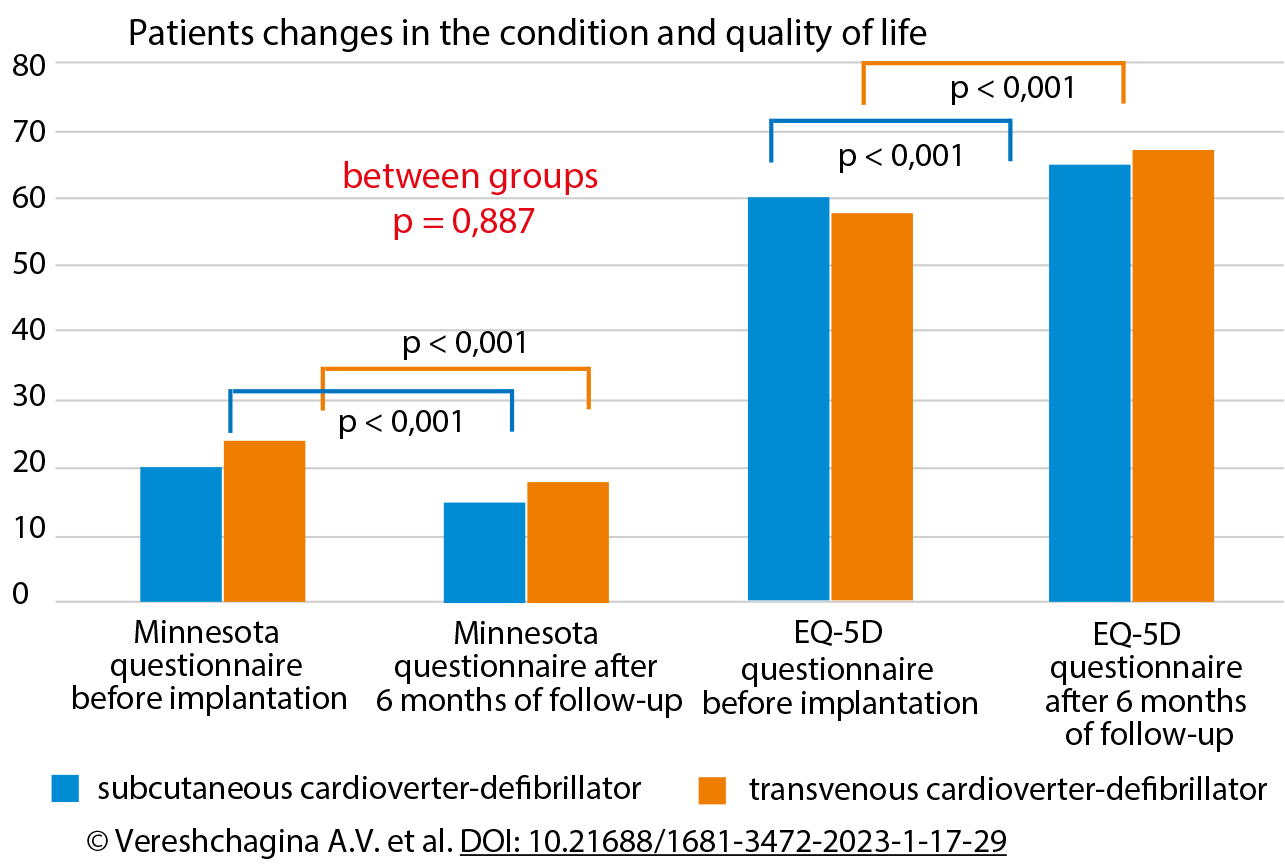
Results: The groups were initially comparable in terms of gender, age, etiology of the disease, and severity of the condition. Male patients prevailed (subcutaneous implantable cardioverter-defibrillators — 90.3%, transvenous implantable cardioverter-defibrillators — 93.0%), the mean age for subcutaneous devices was 56 [49;62] years and 60 [54;65] years for transvenous implantable cardioverter-defibrillators. All patients had chronic heart failure. The median LV EF for subcutaneous implantable cardioverter-defibrillator and transvenous implantable cardioverter-defibrillator was 29% [26;32] and 30% [27;32], respectively, EDV — 220 mL [187;278] and 202 mL [186;248], ESV — 151 mL [126;188] and 145 mL [122;184]. The number of complications recorded during the 6-month follow-up was slightly higher in patients who were implanted with subcutaneous implantable cardioverter-defibrillator (subcutaneous implantable cardioverter-defibrillators — 7.6%, transvenous implantable cardioverter-defibrillators — 2.3%, p = 0.249). The incidence of inadequate shocks in the groups was comparable (7.7% for subcutaneous implantable cardioverter-defibrillators, 6.9% for transvenous implantable cardioverter-defibrillators, p = 0.882). The percentage of using adequate shock therapy was higher in the transvenous implantable cardioverter-defibrillator group, 18.6% versus 5.7% in the subcutaneous implantable cardioverter-defibrillator group (p = 0.051). Implantation of the devices (both subcutaneous and transvenous) improved quality of life according to the results of questionnaires (Minnesota and EQ-5D questionnaires) before implantation and after 6 months of follow-up (p < 0.001 in both groups).
Conclusion: This research demonstrates comparable results for the effectiveness and safety of subcutaneous implantable cardioverter-defibrillators compared with transvenous implantable cardioverter-defibrillators in patients with the need for primary prevention of sudden cardiac death within 6 months.
Received 6 October 2022. Revised 28 February 2023. Accepted 1 March 2023.
Funding: The study did not have sponsorship.
Conflict of interest: The authors declare no conflict of interest.
Contribution of the authors
Conception and study design: A.V. Vereshchagina, T.M. Uskach, O.V. Sapelnikov
Data collection and analysis: A.V. Vereshchagina, V.A. Amanatova, I.R. Grishin
Statistical analysis: A.V. Vereshchagina, V.A. Amanatova
Drafting the article: A.V. Vereshchagina, T.M. Uskach
Critical revision of the article: A.V. Vereshchagina, T.M. Uskach, O.V. Sapelnikov
Final approval of the version to be published: A.V. Vereshchagina, T.M. Uskach, O.V. Sapelnikov, V.A. Amanatova, I.R. Grishin
References
- Al-Khatib S.M., Stevenson W.G., Ackerman M.J., Bryant W.J., Callans D.J., Curtis A.B., Deal B.J., Dickfeld T., Field M.E., Fonarow G.C., Gillis A.M., Granger C.B., Hammill S.C., Hlatky M.A., Joglar J.A., Kay G.N., Matlock D.D., Myerburg R.J., Page R.L. 2017 AHA/ACC/HRS Guideline for management of patients with ventricular arrhythmias and the prevention of sudden cardiac death: A report of the American College of Cardiology/American Heart Association Task Force on Clinical Practice Guidelines and the Heart Rhythm Society. J Am Coll Cardiol. 2018;72(14):e91-e220. PMID: 29097296. https://doi.org/10.1016/j.jacc.2017.10.054
- Peterson P.N., Varosy P.D., Heidenreich P.A., Wang Y., Dewland T.A., Curtis J.P., Go A.S., Greenlee R.T., Magid D.J., Normand Sh.-L.T., Masoudi F.A. Association of single- vs dual-chamber ICDs with mortality, readmissions, and complications among patients receiving an ICD for primary prevention. JAMA. 2013;309(19):2025-2034. PMID: 23677314; PMCID: PMC3752924. https://doi.org/10.1001/jama.2013.4982
- Hauser R.G., Hayes D.L. Increasing hazard of Sprint Fidelis implantable cardioverter-defibrillator lead failure. Heart Rhythm. 2009;6(5):605-610. PMID: 19285920. https://doi.org/10.1016/j.hrthm.2009.02.024
- Jones S.O. 4th, Eckart R.E., Albert C.M., Epstein L.M. Large, single-center, single-operator experience with transvenous lead extraction: outcomes and changing indications. Heart Rhythm. 2008;5(4):520-525. PMID: 18325849. https://doi.org/10.1016/j.hrthm.2008.01.009
- Poole J.E., Gleva M.J., Mela T., Chung M.K., Uslan D.Z., Borge R., Gottipaty V., Shinn T., Dan D., Feldman L.A., Seide H., Winston S.A., Gallagher J.J., Langberg J.J., Mitchell K., Holcomb R.; REPLACE Registry Investigators. Complication rates associated with pacemaker or implantable cardioverter-defibrillator generator replacements and upgrade procedures: results from the REPLACE registry. Circulation. 2010;122(16):1553-1561. PMID: 20921437. https://doi.org/10.1161/CIRCULATIONAHA.110.976076
- Gold M.R., Aasbo J.D., El-Chami M.F., Niebauer M., Herre J., Prutkin J.M., Knight B.P., Kutalek S., Hsu K., Weiss R., Bass E., Husby M., Stivland T.M., Burke M.C. Subcutaneous implantable cardioverter-defibrillator post-approval study: clinical characteristics and perioperative results. Heart Rhythm. 2017;14(10):1456-1463. PMID: 28502872. https://doi.org/10.1016/j.hrthm.2017.05.016
- Kamp N.J., Al-Khatib S.M. The subcutaneous implantable cardioverter-defibrillator in review. Am Heart J. 2019;217:131-139. PMID: 31654943. https://doi.org/10.1016/j.ahj.2019.08.010
- Weiss R., Knight B.P., Gold M.R., Leon A.R., Herre J.M., Hood M., Rashtian M., Kremers M., Crozier I., Lee K.L., Smith W., Burke M.C. Safety and efficacy of a totally subcutaneous implantable-cardioverter defibrillator. Circulation. 2013;128(9):944-953. PMID: 23979626. https://doi.org/10.1161/CIRCULATIONAHA.113.003042
- Knops R.E., Olde Nordkamp L.R.A., Delnoy P.-P.H.M., Boersma L.V.A., Kuschyk J., El-Chami M.F., Bonnemeier H., Behr E.R., Brouwer T.F., Kääb S., Mittal S., Quast A.-F.B.E., Smeding L., van der Stuijt W., de Weger A., de Wilde K.C., Bijsterveld N.R., Richter S., Brouwer M.A., de Groot J.R., Kooiman K.M., Lambiase P.D., Neuzil P., Vernooy K., Alings M., Betts T.R., Bracke F.A.L.E., Burke M.C., de Jong J.S.S.G., Wright D.J., Tijssen J.G.P., Wilde A.A.M.; PRAETORIAN Investigators. Subcutaneous or transvenous defibrillator therapy. N Engl J Med. 2020;383(6):526-536. PMID: 32757521. https://doi.org/10.1056/NEJMoa1915932
- Boston Scientific cardiac rhythm management product performance report. Q3 edition. 2021. Published August 15th, 2021. Availible from: https://www.bostonscientific.com/content/dam/bostonscientific/quality/ppr/2021/q3/Q3%202021%20CRM%20Product%20Performance%20Report%20Rev%20B.pdf
- Quast A.-F.B.E., Baalman S.W.E., Brouwer T.F., Smeding L., Wilde A.A.M., Burke M.C., Knops R.E. A novel tool to evaluate the implant position and predict defibrillation success of the subcutaneous implantable cardioverter-defibrillator: The PRAETORIAN score. Heart Rhythm. 2019;16(3):403-410. PMID: 30292861. https://doi.org/10.1016/j.hrthm.2018.09.029
- Healey J.S., Hohnloser S.H., Glikson M., Neuzner J., Mabo P., Vinolas X., Kautzner J., O'Hara G., VanErven L., Gadler F., Pogue J., Appl U., Gilkerson J., Pochet T., Stein K.M., Merkely B., Chrolavicius S., Meeks B., Foldesi C., Thibault B., Connolly S.J.; Shockless IMPLant Evaluation [SIMPLE] investigators. Cardioverter defibrillator implantation without induction of ventricular fibrillation: a single-blind, non-inferiority, randomised controlled trial (SIMPLE). Lancet. 2015;385(9970):785-791. PMID: 25715991. https://doi.org/10.1016/S0140-6736(14)61903-6
- Bänsch D., Bonnemeier H., Brandt J., Bode F., Svendsen J.H., Táborský M., Kuster S., Blomström-Lundqvist C., Felk A., Hauser T., Suling A., Wegscheider K.; NORDIC ICD Trial Investigators. Intra-operative defibrillation testing and clinical shock efficacy in patients with implantable cardioverter-defibrillators: the NORDIC ICD randomized clinical trial. Eur Heart J. 2015;36(37):2500-2507. PMID: 26112885; PMCID: PMC4589656. https://doi.org/10.1093/eurheartj/ehv292
- Forleo G.B., Gasperetti A., Breitenstein A., Laredo M., Schiavone M., Ziacchi M., Vogler J., Ricciardi D., Palmisano P., Piro A., Compagnucci P., Waintraub X., Mitacchione G., Carrassa G., Russo G., De Bonis S., Angeletti A., Bisignani A., Picarelli F., Casella M., Bressi E., Rovaris G., Calò L., Santini L., Pignalberi C., Lavalle C., Viecca M., Pisanò E., Olivotto I., Curnis A., Dello Russo A., Tondo C., Love C.J., Di Biase L., Steffel J., Tilz R., Badenco N., Biffi M. Subcutaneous implantable cardioverter-defibrillator and defibrillation testing: A propensity-matched pilot study. Heart Rhythm. 2021;18(12):2072-2079. PMID: 34214647. https://doi.org/10.1016/j.hrthm.2021.06.1201
- Kuschyk J., Müller-Leisse J., Duncker D., Tülümen E., Fastenrath F., Fastner C., Kruska M., Akin I., Liebe V., Borggrefe M., Veltmann C., Rudic B. Comparison of transvenous vs subcutaneous defibrillator therapy in patients with cardiac arrhythmia syndromes and genetic cardiomyopathies. Int J Cardiol. 2021;323:100-105. PMID: 32871189. https://doi.org/10.1016/j.ijcard.2020.08.089
- Burke M.C., Gold M.R., Knight B.P., Barr C.S., Theuns D.A.M.J., Boersma L.V.A., Knops R.E., Weiss R., Leon A.R., Herre J.M., Husby M., Stein K.M., Lambiase P.D. Safety and efficacy of the totally subcutaneous implantable defibrillator: 2-year results from a pooled analysis of the IDE Study and EFFORTLESS Registry. J Am Coll Cardiol. 2015;65(16):1605-1615. PMID: 25908064. https://doi.org/10.1016/j.jacc.2015.02.047
- Knops R.E., Brouwer T.F., Barr C.S., Theuns D.A., Boersma L., Weiss R., Neuzil P., Scholten M., Lambiase P.D., Leon A.R., Hood M., Jones P.W., Wold N., Grace A.A., Olde Nordkamp L.R.A., Burke M.C.; IDE and EFFORTLESS investigators. The learning curve associated with the introduction of the subcutaneous implantable defibrillator. Europace. 2016;18(7):1010-1015. PMID: 26324840; PMCID: PMC4927061. https://doi.org/10.1093/europace/euv299
- Basu-Ray I., Liu J., Jia X., Gold M., Ellenbogen K., DiNicolantonio J., Komócsi A., Vorobcsuk A., Kim J., Afshar H., Lam W., Mathuria N., Razavi M., Rasekh A., Saeed M. Subcutaneous versus transvenous implantable defibrillator therapy: a meta-analysis of case-control studies. JACC Clin Electrophysiol. 2017;3(13):1475-1483. PMID: 29759827. https://doi.org/10.1016/j.jacep.2017.07.017
- Brouwer T.F., Yilmaz D., Lindeboom R., Buiten M.S., Olde Nordkamp L.R.A., Schalij M.J., Wilde A.A., van Erven L., Knops R.E. Long-term clinical outcomes of subcutaneous versus transvenous implantable defibrillator therapy. J Am Coll Cardiol. 2016;68(19):2047-2055. PMID: 27810043. https://doi.org/10.1016/j.jacc.2016.08.044
- Gold M.R., Lambiase P.D., El-Chami M.F., Knops R.E., Aasbo J.D., Bongiorni M.G., Russo A.M., Deharo J.-C., Burke M.C., Dinerman J., Barr C.S., Shaik N., Carter N., Stoltz T., Stein K.M., Brisben A.J., Boersma L.V.A.; UNTOUCHED Investigators. Primary results from the understanding outcomes with the S-ICD in primary prevention patients with low ejection fraction (UNTOUCHED) trial. Circulation. 2021;143(1):7-17. PMID: 33073614; PMCID: PMC7752215. https://doi.org/10.1161/CIRCULATIONAHA.120.048728
- Pedersen S.S., Mastenbroek M.H., Carter N., Barr C., Neuzil P., Scholten M., Lambiase P.D., Boersma L., Johansen J.B., Theuns D.A.M.J. A comparison of the quality of life of patients with an entirely subcutaneous implantable defibrillator system versus a transvenous system (from the EFFORTLESS S-ICD quality of life substudy). Am J Cardiol. 2016;118(4):520-526. PMID: 27353211. https://doi.org/10.1016/j.amjcard.2016.05.047
- Pedersen S.S., Carter N., Barr C., Scholten M., Lambiase P.D., Boersma L., Johansen J.B., Theuns D.A.M.J.; EFFORTLESS Investigators. Quality of life, depression, and anxiety in patients with a subcutaneous versus transvenous defibrillator system. Pacing Clin Electrophysiol. 2019;42(12):1541-1551. PMID: 31677279. https://doi.org/10.1111/pace.13828
- Migliore F., Mattesi G., De Franceschi P., Allocca G., Crosato M., Calzolari V., Fantinel M., Ortis B., Facchin D., Daleffe E., Fabris T., Marras E., De Lazzari M., Zanon F., Marcantoni L., Siciliano M., Corrado D., Iliceto S., Bertaglia E., Zecchin M. Multicentre experience with the second-generation subcutaneous implantable cardioverter defibrillator and the intermuscular two-incision implantation technique. J Cardiovasc Electrophysiol. 2019;30(6):854-864. PMID: 30827041; PMCID: PMC6850019. https://doi.org/10.1111/jce.13894