Combined method of renal denervation in an animal model
 D.I. Bashta
- L.I. Vilenskiy
- Yu.S. Krivosheev
- A.A. Simonyan
- A.B. Romanov
Published 2022-12-29
Keywords
- Animals,
- Creatinine,
- Demyelinating Diseases,
- Denervation,
- Electric Stimulation
- Hypertension,
- Uric Acid ...More
How to Cite
Copyright (c) 2022 Bashta D.I., Vilenskiy L.I., Krivosheev Yu.S., Simonyan A.A., Romanov A.B.

This work is licensed under a Creative Commons Attribution 4.0 International License.
Abstract
Background: Currently, intra-arterial radiofrequency renal denervation is an only interventional treatment for resistant hypertension. However, available data are controversial since this method does not provide the long-term hypotensive effect.
Objective: To compare the safety and efficacy of laparoscopic mechanical renal denervation and laparoscopic combined renal denervation using a radiofrequency clamp.
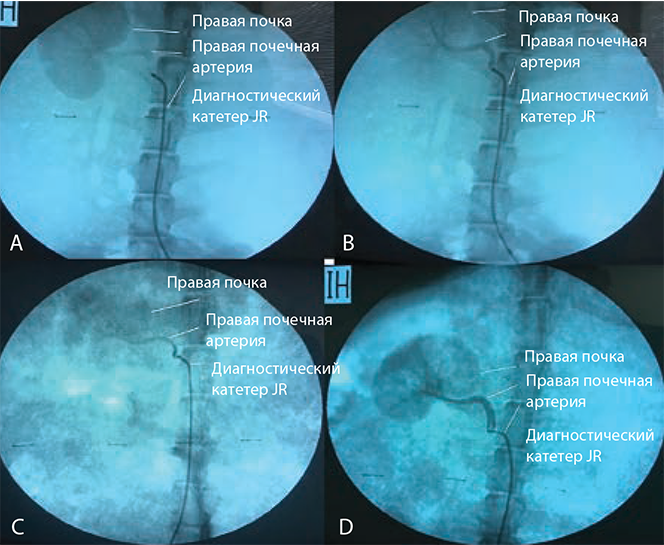
Methods: Thirty sheep weighing 93.00 ± 3.72 kg were divided into two groups for mechanical laparoscopic renal denervation (group I, n = 15) and combined laparoscopic renal denervation with a radiofrequency clamp (group II, n = 15). The observation period lasted for six months. We assessed the following parameters: blood pressure (BP) in response to high-frequency electric stimulation from the lumen of the vessel, creatinine and uric acid levels, iatrogenic damage to the renal arteries based on angiography findings, and destruction of nerve fibers based on histological findings.
Results: All the animals survived throughout the observation period. Creatinine and uric acid levels were within the normal ranges. Renal angiography did not reveal any iatrogenic stenosis. After six months, we found some BP response (elevated systolic BP ∆66.73 ± 6.63 mm Hg [p < 0.001], elevated diastolic BP ∆47.27 ± 5.98 mm Hg [p < 0.001]) to high-frequency electric stimulation in group I and no hypertensive response in group II. After six months, the animals were withdrawn for further histological assessment. Histology revealed complete destruction of the nerve fiber (demyelination) in group II and vacuolized swollen nerve fibers without any signs of demyelination in group I.
Conclusion: Laparoscopic combined renal denervation is a safe and efficacious method with a stable hypotensive effect after six months in an animal model as compared to laparoscopic mechanical renal denervation.
Received 30 March 2022. Revised 5 December 2022. Accepted 9 December 2022.
Funding: The study did not have sponsorship.
Conflict of interest: Authors declare no conflict of interest.
Contribution of the authors
Conception and study design: D.I. Bashta, L.I. Vilenskiy, A.B. Romanov
Data collection and analysis: D.I. Bashta, Yu.S. Krivosheev, A.A. Simonyan
Statistical analysis: D.I. Bashta, Yu.S. Krivosheev
Drafting the article: D.I. Bashta, Yu.S. Krivosheev
Critical revision of the article: L.I. Vilenskiy, Yu.S. Krivosheev, A.B. Romanov
Final approval of the version to be published: D.I. Bashta, L.I. Vilenskiy, Yu.S. Krivosheev, A.A. Simonyan, A.B. Romanov
References
- Кобалава Ж.Д., Конради А.О., Недогода С.В., Шляхто Е.В., Арутюнов Г.П., Баранова Е.И., Барбараш О.Л., Бойцов С.А., Вавилова Т.В., Виллевальде С.В., Галявич А.С., Глезер М.Г., Гринева Е.Н., Гринштейн Ю.И., Драпкина О.М., Жернакова Ю.В., Звартау Н.Э., Кисляк О.А., Козиолова Н.А., Космачева Е.Д., Котовская Ю.В., Либис Р.А., Лопатин Ю.М., Небиеридзе Д.В., Недошивин А.О., Остроумова О.Д., Ощепкова Е.В., Ратова Л.Г., Скибицкий В.В., Ткачева О.Н., Чазова И.Е., Чесникова А.И., Чумакова Г.А., Шальнова С.А., Шестакова М.В., Якушин С.С., Янишевский С.Н. Артериальная гипертензия у взрослых. Клинические рекомендации 2020. Российский кардиологический журнал. 2020;25(3):3786. http://dx.doi.org/10.15829/1560-4071-2020-3-3786 Kobalava Z.D., Konradi A.O., Nedogoda S.V., Shlyakhto E.V., Arutyunov G.P., Baranova E.I., Barbarash O.L., Boitsov S.A., Vavilova T.V., Villevalde S.V., Galyavich A.S., Glezer M.G., Grineva E.N., Grinstein Yu.I., Drapkina O.M., Zhernakova Yu.V., Zvartau N.E., Kislyak O.A., Koziolova N.A., Kosmacheva E.D., Kotovskaya Yu.V., Libis R.A., Lopatin Yu.M., Nebiridze D.V., Nedoshivin A.O., Ostroumova O.D., Oschepkova E.V., Ratova L.G., Skibitsky V.V., Tkacheva O.N., Chazova I.E., Chesnikova A.I., Chumakova G.A., Shalnova S.A., Shestakova M.V., Yakushin S.S., Yanishevsky S.N. Arterial hypertension in adults. Clinical guidelines 2020. Russian Journal of Cardiology. 2020;25(3):3786. (In Russ.) https://doi.org/10.15829/1560-4071-2020-3-3786
- Swales J.D., Bing R.F., Heagerty A., Pohl J.E., Russell G.I., Thurston H. Treatment of refractory hypertension. Lancet. 1982;1(8277):894-896. PMID: 6122111. https://doi.org/10.1016/S0140-6736(82)92162-6
- ALLHAT Officers and Coordinators for the ALLHAT Collaborative Research Group. The antihypertensive and lipid-lowering treatment to prevent heart attack trial. Major outcomes in high-risk hypertensive patients randomized to angiotensin—converting enzyme inhibitor or calcium channel blocker vs diuretic: the antihypertensive and lipid-lowering treatment to prevent heart attack trial (ALLHAT). JAMA. 2002;288(23):2981-2997. PMID: 12479763. https://doi.org/10.1001/jama.288.23.2981
- Staessen J.A., Fagard R., Thijs L., Celis H., Arabidze G.G., Birkenhäger W.H., Bulpitt C.J., de Leeuw P.W., Dollery C.T., Fletcher A.E., Forette F., Leonetti G., Nachev C., O'Brien E.T., Rosenfeld J., Rodicio J.L., Tuomilehto J., Zanchetti A. Randomised double-blind comparison of placebo and active treatment for older patients with isolated systolic hypertension. Lancet. 1997;350(9080):757-764. PMID: 9297994. https://doi.org/10.1016/S0140-6736(97)05381-6
- Franklin S.S., Lopez V.A., Wong N.D., Mitchell G.F., Larson M.G., Vasan R.S., Levyet D. Single versus combined blood pressure components and risk for cardiovascular disease: the Framingham heart study. Circulation. 2009;119:243-250. PMID: 19118251, PMCID: PMC3042701. https://doi.org/10.1161/CIRCULATIONAHA.108.797936
- Noubiap J.J., Nansseu J.R., Nyaga U.F., Sime P.S., Francis I., Bigna J.J. Global prevalence of resistant hypertension: a meta-analysis of data from 3.2 million patients. Heart. 2019;105:98-105. PMID: 30087099. https://doi.org/10.1136/heartjnl-2018-313599
- Bhatt D.L., Kandzari D.E., O’Neill W.W., D'Agostino R., Flack J.M., Katzen B.T., Leon M.B., Liu M., Mauri L., Negoita M., Cohen S.A., Oparil S. A controlled trial of renal denervation for resistant hypertension. N Engl J Med. 2014;370(15):1393-1401. PMID: 24678939. https://doi.org/10.1056/NEJMoa1402670
- Esler M.D., Böhm M., Sievert H., Rump C.L., Schmieder R.E., Krum H., Mahfoud F., Schlaich M.P. Catheter-based renal denervation for treatment of patients with treatment-resistant hypertension: 36 month results from the SYMPLICITY HTN-2 randomized clinical trial. Eur Heart J. 2014;35(26):1752-1759. PMID: 24898552. https://doi.org/10.1093/eurheartj/ehu209
- Esler M.D., Krum H., Sobotka P.A., Schlaich M.P., Schmieder R.F., Böhm M. Renal sympathetic denervation in patients with treatment resistant hypertension: a randomised control trial. Lancet. 2010;376(9756):1903-1909. PMID: 21093036. https://doi.org/10.1016/S0140-6736(10)62039-9
- Krum H., Barman N., Schlaich M., Sobotka P.A., Esler M., Mahfoud F., Bohm M., Dunlap M. Catheter-based renal sympathetic denervation for resistant hypertension: durability of blood pressure reduction out to 24 months. Hypertension. 2011;57(5):911-917. PMID: 21403086. https://doi.org/10.1161/HYPERTENSIONAHA.110.163014
- Mahfoud F., Ukena C., Schmieder R.E., Cremers B., Rump L.C., Vonend O., Weil J., Schmidt M., Hoppe U.C., Zeller T., Bauer A., Ott C., Blessing E., Sobotka P.A., Krum H., Schlaich M., Esler M., Böhm M. Ambulatory blood pressure changes after renal sympathetic denervation in patients with resistant hypertension. Circulation. 2013;128(2):132-140. PMID: 23780578. https://doi.org/10.1161/CIRCULATIONAHA.112.000949
- Pocock S.J., Bakris G., Bhatt D.L., Brar S., Fahy M., Gersh B.J. Regression to the mean in SYMPLICITY HTN-3: implications for design and reporting of future trials. J Am Coll Cardiol. 2016;68(18):2016-2025. PMID: 27788856. https://doi.org/10.1016/j.jacc.2016.07.775
- Заманов Д.А., Дмитриев А.Ю., Антонов С.И., Пристромова Л.В., Иваницкая Э.Э., Пустовойтов А.В., Корчагин Е.Е., Артеменко С.Н., Шабанов В.В., Романов А.Б., Покушалов Е.А. Роль ренальной денервации в улучшении результатов катетерной аблации у пациентов с фибрилляцией предсердий и артериальной гипертензией. Патология кровообращения и кардиохирургия. 2015;19(4):119-129. https://doi.org/10.21688/1681-3472-2015-4-119-129 Zamanov D.A.., Dmitriev А.Yu., Antonov S.I., Pristromova L.V., Ivanitskaya E.E., Pustovoitov А.V., Korchagin Е.E., Artemenko S.N., Shabanov V.V., Romanov А.B., Pokushalov Е.A. Renal denervation to improve catheter ablation outcomes in patients with arterial hypertension and atrial fibrillation. Patologiya krovoobrashcheniya i kardiokhirurgiya = Circulation Pathology and Cardiac Surgery. 2015;19(4):119-129. (In Russ.) https://doi.org/10.21688/1681-3472-2015-4-119-129
- Романов А.Б., Покушалов Е.А., Заманов Д.А., Дмитриев А.Ю., Шильников Н.В., Иваницкая Э.Э., Пустовойтов А.В. Модуляция автономной нервной системы кровообращения с помощью денервации почечных артерий для лечения фибрилляции предсердий. Патология кровообращения и кардиохирургия. 2014;18(4):113-122. https://doi.org/10.21688/1681-3472-2014-4-113-122 Romanov А.B., Pokushalov Е.A., Zamanov D.A., Dmitriev А. Yu., Shilnikov N.V., Ivanitskaya E.E., Pustovoytov А.V. Modulation of sympathetic nervous system by means of renal denervation for treatment of atrial fibrillation. Patologiya krovoobrashcheniya i kardiokhirurgiya = Circulation Pathology and Cardiac Surgery. 2014;18(4):113-122. (In Russ.) https://doi.org/10.21688/1681-3472-2014-4-113-122
- Verloop W.L., Hubens E.G., Spiering W., Doevendans P.A., Goldschmeding R., Ronald L.A.W., Voskuil M., Voskuil B. The effects of renal denervation on renal hemodynamics and renal vasculature in a porcine model. PLoS One. 2015;10(11):e0141609. PMID: 26587981. https://doi.org/10.1371/journal.pone.0141609
- Башта Д.И., Романов А.Б., Колесников В.Н., Байчоров Э.Х., Виленский Л.И., Трухачев В.И., Криворучко А.Ю., Данников С.П. Ренальная денервация — новые подходы в поисках оптимизации гипотензивного эффекта. Медицинский вестник Северного Кавказа. 2017;12(4):431-435. (In Russ.) https://doi.org/10.14300/mnnc.2017.12121 Bashta D., Romanov A., Kolesnikov V., Baychorov E., Vilensky I., Trukhachev V., Krivoruchko A., Dannikov S. Renal denervation—new approaches in the search for optimization of hypotensive effect. Medical News of North Caucasus. 2017;12(4):431-435. https://doi.org/10.14300/mnnc.2017.12121