Evaluation of the original sealant with antibacterial effect for synthetic vascular grafts
 A.A. Shadanov
- I.Yu. Zhuravleva
- L.M. Samoylova
- T.P. Timchenko
- S.V. Vladimirov
- E.V. Karpova
- N.E. Luchnikov
- D.A. Sirota
- A.G. Edemskiy
- A.V. Bogachev-Prokofiev
- A.M. Chernyavskiy
Published 2023-03-30
Keywords
- Gelatin,
- Permeability,
- Polyethylene Terephthalates,
- Vancomycin
How to Cite
Copyright (c) 2023 Shadanov A.A., Zhuravleva I.Yu., Samoylova L.M., Timchenko T.P., Vladimirov S.V., Karpova E.V., Luchnikov N.E., Sirota D.A., Edemskiy A.G., Bogachev-Prokofiev A.V., Chernyavskiy A.M.

This work is licensed under a Creative Commons Attribution 4.0 International License.
Abstract
Background: Vascular graft infection is a severe cardiovascular complication with high mortality rates. Antibacterial vascular graft coatings are widely used and continue to be improved.
Objective: To develop a sealant with antimicrobial effect for Dacron vascular grafts and experimentally test the coating properties.
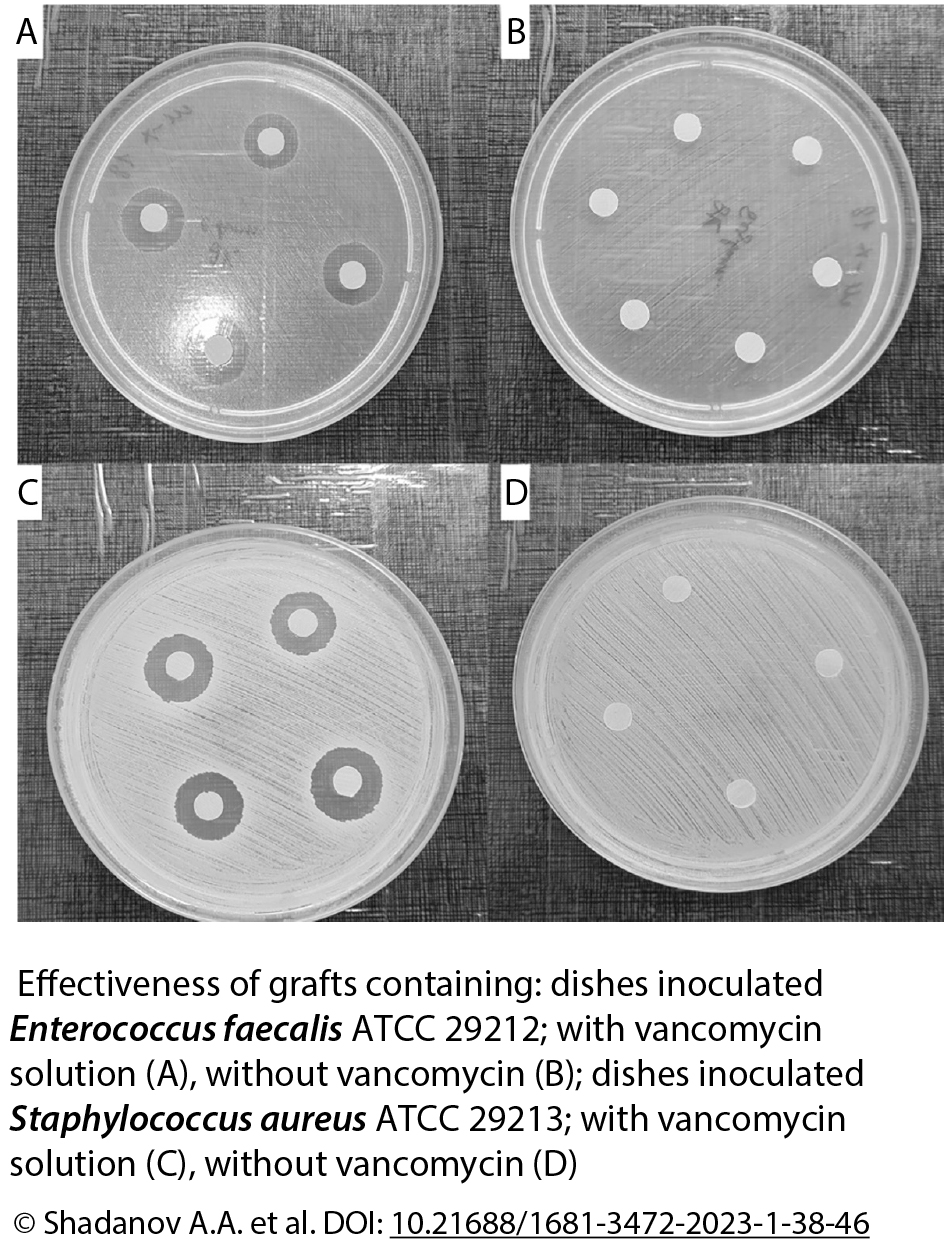
Methods: We used 2 types of vascular grafts: graft No. 1 (plain weave) with initial water permeability of 78.8 ± 2.7 mL/cm2/min and graft No. 2 (2/1 twill + 6/4 satin weave) with water permeability of 549.8 ± 20.7 mL/cm2/min. We developed an original gelatin impregnation technique, tested it using a scanning electron microscopy, and measured water permeability and kink radius. We evaluated the antibacterial activity of vancomycin and gelatin impregnation by the disk diffusion test using media with Staphylococcus aureus ATCC 29213 and Enterococcus faecalis ATCC 29212 and measured inhibition zones after 24-hour incubation. We used samples cut out of grafts with vancomycin-containing (experimental group) and no vancomycin-containing (control group) impregnation.
Results: The gelatin coating of the samples is visualized as a thin even film and provides zero water permeability. On the negative side, it increased stiffness and the kink radius. Thanks to vancomycin added to the coating, bacterial growth significantly inhibits: the mean diameter of the growth inhibition zone for Staphylococcus aureus and Enterococcus faecalis was 15.60 ± 0.65 and 14.40 ± 0.66 mm, respectively. The grafts untreated with vancomycin showed no growth inhibition zones.
Conclusion: Vascular graft treatment with gelatin impregnation and vancomycin solution is a simple measure to prevent the growth of gram-positive bacteria on vascular grafts.
Received 14 November 2022. Revised 15 December 2022. Accepted 19 December 2022.
Funding: The work was supported by Russian Science Foundation and the government of the Novosibirsk region (project No. 22-15-20005).
Conflict of interest: The authors declare no conflict of interest.
Contribution of the authors
Conception and study design: I.Yu. Zhuravleva, A.A. Shadanov, D.A. Sirota
Data collection and analysis: A.A. Shadanov, L.M. Samoylova, S.V. Vladimirov, T.P. Timchenko, N.E. Luchnikov, E.V. Karpova
Statistical analysis: A.A. Shadanov
Drafting the article: A.A. Shadanov, L.M. Samoylova, T.P. Timchenko, A.G. Edemskiy
Critical revision of the article: D.A. Sirota, I.Yu. Zhuravleva, A.V. Bogachev-Prokofiev, A.M. Chernyavskiy
Final approval of the version to be published: A.A. Shadanov, I.Yu. Zhuravleva, L.M. Samoylova, T.P. Timchenko, S.V. Vladimirov, E.V. Karpova, N.E. Luchnikov, D.A. Sirota, A.G. Edemskiy, A.V. Bogachev-Prokofiev, A.M. Chernyavskiy
References
- Chakfé N., Bizonne S.C., Beaufigeau M., Urban E., Cardon A., Doillon C., Le Magnen J.F., Durand B., Kretz J.G. Impregnated polyester arterial prostheses: performance and prospects. Ann Vasc Surg. 1999;13(5):509-523. PMID: 10466995. https://doi.org/10.1007/s100169900291
- Halpert B., De Bakey M.E., Jordan Jr G.L., Henly W.S. The fate of homografts and prostheses of the human aorta. Surg Gynecol Obstet. 1960;111:659-674. PMID: 13710927.
- Humphries A.W., Hawk W.A., Cuthbertson A.M. Arterial prosthesis of collagen-impregnated Dacron tulle. Surgery. 1961;50:947-954. PMID: 14449985.
- Bascom J.U. Gelatin sealing to prevent blood loss from knitted arterial grafts. Surgery. 1961;50:504-512. PMID: 13687562.
- Prager M., Polterauer P., Böhmig H.J., Wagner O., Fügl A., Kretschmer G., Plohner M., Nanobashvili J., Huk I. Collagen versus gelatin-coated Dacron versus stretch polytetrafluoroethylene in abdominal aortic bifurcation graft surgery: Results of a seven-year prospective, randomized multicenter trial. Surgery. 2001;130(3):408-414. PMID: 11562661. https://doi.org/10.1067/msy.2001.115904
- Lacroix H., Boel K., Nevelsteen A., Suy R. Early inflammatory response to gelatin- and collagen-sealed Dacron prostheses. Ann Vasc Surg. 1995;9(2):152-154. PMID: 7786700. https://doi.org/10.1007/bf02139657
- Domurado D., Thomas D., Brown G. A new method for producing proteic coatings. J Biomed Mater Res. 1975;9(1):109-110. PMID: 809444. https://doi.org/10.1002/jbm.820090110
- Wilson W.R., Bower T.C., Creager M.A., Amin-Hanjani S., O’Gara P.T., Lockhart P.B., Darouiche R.O., Ramlawi B., Derdeyn C.P., Bolger A.F., Levison M.E., Taubert K.A., Baltimore R.S., Baddour L.M.; American Heart Association Committee on Rheumatic Fever, Endocarditis, and Kawasaki Disease of the Council on Cardiovascular Disease in the Young; Council on Cardiovascular and Stroke Nursing; Council on Cardiovascular Radiology and Intervention; Council on Cardiovascular Surgery and Anesthesia; Council on Peripheral Vascular Disease; and Stroke Council. Vascular graft infections, mycotic aneurysms, and endovascular infections: a scientific statement from the American Heart Association. Circulation. 2016;134(20):e412-e460. PMID: 27737955. https://doi.org/10.1161/cir.0000000000000457
- Hall-Stoodley L., Costerton J.W., Stoodley P. Bacterial biofilms: from the natural environment to infectious diseases. Nat Rev Microbiol. 2004;2(2):95-108. PMID: 15040259. https://doi.org/10.1038/nrmicro821
- Gandelman G., Frishman W.H., Wiese C., Green-Gastwirth V., Hong S., Aronow W.S., Horowitz H.W. Intravascular device infections: epidemiology, diagnosis, and management. Cardiol Rev. 2007;15(1):13-23. PMID: 17172879. https://doi.org/10.1097/01.crd.0000197966.53529.67
- Herten M., Idelevich E.A., Sielker S., Becker K., Scherzinger A.S., Osada N., Torsello G.B., Bisdas T. Vascular graft impregnation with antibiotics: the influence of high concentrations of rifampin, vancomycin, daptomycin, and bacteriophage endolysin hy-133 on viability of vascular cells. Med Sci Monit Basic Res. 2017;23:250-257. PMID: 28652563; PMCID: PMC5498120. https://doi.org/10.12659/msmbr.902879
- Berard X., Puges M., Pinaquy J.-B., Cazanave C., Stecken L., Bordenave L., Pereyre S., M'Zali F. In vitro evidence of improved antimicrobial efficacy of silver and triclosan containing vascular grafts compared with rifampicin soaked grafts. Eur J Vasc Endovasc Surg. 2019;57(3):424-432. PMID: 30301647. https://doi.org/10.1016/j.ejvs.2018.08.053
- Szałapata K., Osińska-Jaroszuk M., Kapral-Piotrowska J., Pawlikowska-Pawlęga B., Łopucki R., Mroczka R., Jarosz-Wilkołazka A. Serine protease inhibitors — new molecules for modification of polymeric biomaterials. Biomolecules. 2020;10(1):82. PMID: 31947983; PMCID: PMC7023003. https://doi.org/10.3390/biom10010082
- Lew W., Moore W. Antibiotic-impregnated grafts for aortic reconstruction. Semin Vasc Surg. 2011;24(4):211-219. PMID: 22230676. https://doi.org/10.1053/j.semvascsurg.2011.10.015
- Saw M.M., Chandler B., Ho K.M. Benefits and risks of using gelatin solution as a plasma expander for perioperative and critically ill patients: A meta-analysis. Anaesth Intensive Care. 2012;40(1):17-32. PMID: 22313061. https://doi.org/10.1177/0310057x1204000104
- Журавлева И.Ю., Ляшенко М.М., Шаданов А.А., Сирота Д.А., Чернявский А.М. Quo vadimus? Фундаментальные проблемы разработки гибридных протезов грудной аорты. Ангиология и сосудистая хирургия. 2021;27(4):103-112. https://doi.org/10.33529/ANGIO2021412 Zhuravleva I.Yu, Lyashenko M.M., Shadanov A.A., Sirota D.A., Chernyavskiy A.M. Quo vadimus? Fundamental problems of developing hybrid prostheses of thoracic aorta. Angiologiia i Sosudistaia Khirurgiia = Angiology and Vascular Surgery. 2021;27(4):103-112. (In Russ.) https://doi.org/10.33529/ANGIO2021412
- Gristina A.G. Biomaterial-centered infection: microbial adhesion versus tissue integration. Science. 1987;237(4822):1588-1595. PMID: 3629258. https://doi.org/10.1126/science.3629258
- Schmitt D.D., Bandyk D.F., Pequet A.J., Towne J.B. Bacterial adherence to vascular prostheses. A determinant of graft infectivity. J Vasc Surg. 1986;3(5):732-740. PMID: 2939263.
- Moore W.S., Chvapil M., Seiffert G., Keown K. Development of an infection-resistant vascular prosthesis. Arch Surg. 1981;116(11):1403-1407. PMID: 6458258. https://doi.org/10.1001/archsurg.1981.01380230027004
- Zilberman M., Elsner J.J. Antibiotic-eluting medical devices for various applications. J Control Release. 2008;130(3):202-215. PMID: 18687500. https://doi.org/10.1016/j.jconrel.2008.05.020
- Chervu A., Moore W.S., Gelabert H.A., Colburn M.D., Chvapil M. Prevention of graft infection by use of prostheses bonded with a rifampin/collagen release system. J Vasc Surg. 1991;14(4):521-525. PMID: 1833564. https://doi.org/10.1016/0741-5214(91)90246-Q
- Galdbart J.O., Branger C., Andreassian B., Lambert-Zechovsky N., Kitzis M. Elution of six antibiotics bonded to polyethylene vascular grafts sealed with three proteins. J Surg Res. 1996;66(2):174-178. PMID: 9024831. https://doi.org/10.1006/jsre.1996.0391
- Goëau-Brissonnière O., Leport C., Bacourt F., Lebrault C., Comte R., Pechère J.C. Prevention of vascular graft infection by rifampin bonding to a gelatin-sealed Dacron graft. Ann Vasc Surg. 1991;5(5):408-412. PMID: 1835641. https://doi.org/10.1007/bf02133043
- Morishima M., Marui A., Yanagi S., Nomura T., Nakajima N., Hyon S.-H., Ikeda T., Sakata R. Sustained release of vancomycin from a new biodegradable glue to prevent methicillin-resistant Staphylococcus aureus graft infection. Interact Cardiovasc Thorac Surg. 2010;11(1):52-55. PMID: 20360210. https://doi.org/10.1510/icvts.2010.232447
- Blanchemain N., Laurent T., Chai F., Neut C., Haulon S., Krump-konvalinkova V., Morcellet M., Martel B., Kirkpatrick C.J., Hildebrand H.F. Polyester vascular prostheses coated with a cyclodextrin polymer and activated with antibiotics: cytotoxicity and microbiological evaluation. Acta Biomater. 2008;4(6):1725-1733. PMID: 18676187. https://doi.org/10.1016/j.actbio.2008.07.001