
Severity scale of coronary microvascular obstruction (no-reflow) during percutaneous coronary interventions in myocardial infarction patients
 A.A. Frolov
- I.G. Pochinka
- I.A. Frolov
- K.V. Kuzmichev
- A.S. Mukhin
- E.G. Sharabrin
- V.N. Sinyutin
Published 2023-12-26
Keywords
- Cohort Studies,
- Coronary Occlusion,
- Myocardial Infarction,
- No-Reflow Phenomenon,
- Percutaneous Coronary Intervention
How to Cite
Copyright (c) 2023 Frolov A.A., Pochinka I.G., Frolov I.A., Kuzmichev K.V., Mukhin A.S., Sharabrin E.G., Sinyutin V.N.

This work is licensed under a Creative Commons Attribution 4.0 International License.
Abstract
Introduction: There is no scale that combines the traditional criteria of coronary microvascular obstruction (CMVO, no-reflow phenomenon) to effectively assess the severity and prognosis of this complication.
Objective: To develop and evaluate the severity scale of CMVO during percutaneous coronary intervention (PCI) for myocardial infarction (MI).
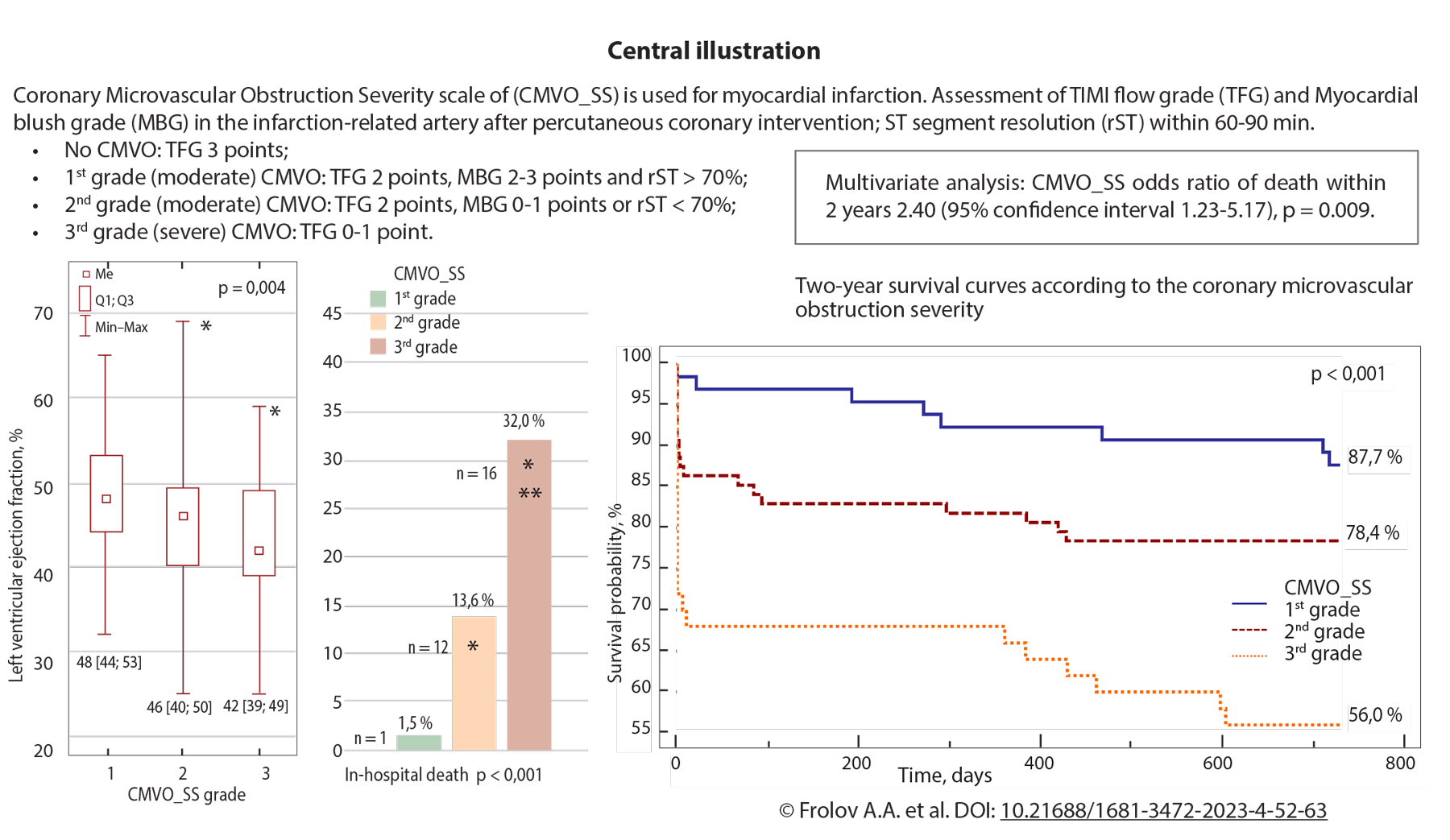
Methods: The cohort study included 203 patients diagnosed with type 1 MI and CMVO during PCI. The CMVO criterion was TIMI flow grade (TFG) <3 points. Using the proposed "CMVO Severity Scale" (CMVO-SS), three groups of patients were identified. CMVO grade 1 (mild): TFG 2 points, Myocardial blush grade (MBG) 2–3 points, ST segment resolution after PCI (rST) >70%. CMVO grade 2 (moderate): TFG 2 points, MBG 0–1 points or rST <70%. CMVO grade 3 (severe): TFG 0-1 points.
Results: Distribution of groups with CMVO of the 1st, 2nd, and 3rd grade is 65 (32%) / 88 (43%) / 50 (25%) patients, respectively. Outcomes by group: acute heart failure grade 3–4 — 2 (3%) / 11 (13%) / 14 (28%), P < .001; ejection fraction — 48 [44; 53] % / 46 [40; 50] % / 42 [39; 49] %, P = .004; in-hospital death — 1 (1.5%) / 12 (13.6%) / 16 (32.0%), P < .001; two-year death — 8 (12.3%) / 19 (21.6%) / 22 (44.0%), P < .001. The multivariate analysis revealed a two-year death odds ratio for the CMVO-SS of 2.40 [95% CI 1.23–5.17], P = .009. Two-year survival probability with CMVO-SS grade 1 was 87.7%, grade 2 — 78.4%, grade 3 — 56.0% (P < .001).
Conclusion: The proposed CMVO severity scale is associated with adverse in-hospital outcomes and two-year mortality.
Received 15 May 2023. Revised 27 September 2023. Accepted 24 October 2023.
Funding: The study was supported by the "Priority 2030" program.
Conflict of interest: The authors declare no conflict of interest.
Contribution of the authors
Conception and study design: A.A. Frolov, E.G. Sharabrin, I.G. Pochinka
Data collection and analysis: A.A. Frolov, I.A. Frolov, K.V. Kuzmichev
Statistical analysis: A.A. Frolov, I.A. Frolov, K.V. Kuzmichev
Drafting the article: A.A. Frolov, I.G. Pochinka, I.A. Frolov
Critical revision of the article: I.G. Pochinka, A.S. Mukhin, E.G. Sharabrin, V.N. Sinyutin
Final approval of the version to be published: A.A. Frolov, I.G. Pochinka, I.A. Frolov, K.V. Kuzmichev, A.S. Mukhin, E.G. Sharabrin, V.N. Sinyutin
References
- Ciofani J.L., Allahwala U.K., Scarsini R., Ekmejian A., Banning A.P., Bhindi R., De Maria G.L. No-reflow phenomenon in ST-segment elevation myocardial infarction: still the Achilles' heel of the interventionalist. Future Cardiol. 2021;17(2):383-397. PMID: 32915083. https://dx.doi.org/10.2217/fca-2020-0077
- Konijnenberg L.S.F., Damman P., Duncker D.J., Kloner R.A., Nijveldt R., van Geuns R.-J.M., Berry C., Riksen N.P., Escaned J., van Royen N. Pathophysiology and diagnosis of coronary microvascular dysfunction in ST-elevation myocardial infarction. Cardiovasc Res. 2020;116(4):787-805. PMID: 31710673; PMCID: PMC7061278. https://dx.doi.org/10.1093/cvr/cvz301
- Kaur G., Baghdasaryan P., Natarajan B., Sethi P., Mukherjee A., Varadarajan P., Pai R.G. Pathophysiology, diagnosis, and management of coronary no-reflow phenomenon. Int J Angiol. 2021;30(1):15-21. PMID: 34025092; PMCID: PMC8128485. https://dx.doi.org/10.1055/s-0041-1725979
- Niccoli G., Montone R.A., Ibanez B., Thiele H., Crea F., Heusch G., Bulluck H., Hausenloy D.J., Berry C., Stiermaier T., Camici P.G., Eitel I. Optimized treatment of ST-elevation myocardial infarction. Circ Res. 2019;125(2):245-258. PMID: 31268854. https://dx.doi.org/10.1161/circresaha.119.315344
- Фролов А.А., Починка И.Г., Шахов Б.Е., Шарабрин Е.Г., Кузьмичев К.В. Феномен коронарной микрососудистой обструкции (no-reflow) при проведении чрескожных коронарных вмешательств у пациентов с инфарктом миокарда. Патология кровообращения и кардиохирургия. 2020;24(1):18-27. https://dx.doi.org/10.21688/1681-3472-2020-1-18-27 Frolov A.A., Pochinka I.G., Shakhov B.E., Sharabrin E.G., Kuzmichev K.V. Coronary microvascular obstruction (the no-reflow phenomenon) during percutaneous coronary interventions in patients with myocardial infarction. Patologiya krovoobrashcheniya i kardiokhirurgiya = Circulation Pathology and Cardiac Surgery. 2020;24(1):18-27. (In Russ.) https://dx.doi.org/10.21688/1681-3472-2020-1-18-27
- Ibanez B., James S., Agewall S., Antunes M.J., Bucciarelli-Ducci C., Bueno H., Caforio A.L.P., Crea F., Goudevenos J.A., Halvorsen S., Hindricks G., Kastrati A., Lenzen M.J., Prescott E., Roffi M., Valgimigli M., Varenhorst C., Vranckx P., Widimský P.; ESC Scientific Document Group. 2017 ESC Guidelines for the management of acute myocardial infarction in patients presenting with ST-segment elevation: The Task Force for the management of acute myocardial infarction in patients presenting with ST-segment elevation of the European Society of Cardiology (ESC). Eur Heart J. 2018;39(2):119-177. PMID: 28886621. https://dx.doi.org/10.1093/eurheartj/ehx393
- Kim D.-W., Her S.-H., Park M.-W., Cho J.S., Kim T.-S., Kang H., Sim D.S., Hong Y.J., Kim J.H., Ahn Y., Chang K., Chung W.-S., Seung K.-B., Jeong M.-H., Rho T.-H. Impact of postprocedural TIMI flow on long-term clinical outcomes in patients with acute myocardial infarction. Int Heart J. 2017;58(5):674-685. PMID: 28966314. https://dx.doi.org/10.1536/ihj.16-448
- Rehman A.-U., Malik J., Javed N., Iftikhar I., Sharif H. Myocardial blush grade: a determinant of left ventricular ejection fraction and adverse outcomes in STEMI. Scott Med J. 2021;66(1):34-39. PMID: 32631149. https://dx.doi.org/10.1177/0036933020941260
- Bianco H.T., Povoa R., Izar M.C., Luna Filho B., Moreira F.T., Stefanini E., Fonseca H.A., Barbosa A.H.P., Alves C.M.R., Caixeta A.M., Gonçalves I. Jr, Moraes P.I.M., Lopes R.D., de Paola A.A.V., Almeida D., Moises V.A., Fonseca F.A.H. Accuracy of post-thrombolysis ST-segment reduction as an adequate reperfusion predictor in the pharmaco-invasive approach. Arq Bras Cardiol. 2021;117(1):15-25. PMID: 34320062; PMCID: PMC8294746. https://dx.doi.org/10.36660/abc.20200241
- Thygesen K., Alpert J.S., Jaffe A.S., Chaitman B.R., Bax J.J., Morrow D.A., White H.D.; Executive Group on behalf of the Joint European Society of Cardiology (ESC) / American College of Cardiology (ACC) / American Heart Association (AHA) / World Heart Federation (WHF) Task force for the Universal Definition of Myocardial Infarction. Fourth universal definition of myocardial infarction (2018). Glob Heart. 2018;13(4):305-338. PMID: 30154043. https://dx.doi.org/10.1016/j.gheart.2018.08.004
- Mansournia M.A., Geroldinger A., Greenland S., Heinze G. Separation in logistic regression: causes, consequences, and control. Am J Epidemiol. 2018;187(4):864-870. PMID: 29020135. https://dx.doi.org/10.1093/aje/kwx299
- Austin P.C., White I.R., Lee D.S., van Buuren S. Missing data in clinical research: a tutorial on multiple imputation. Can J Cardiol. 2021;37(9):1322-1331. PMID: 33276049; PMCID: PMC8499698. https://dx.doi.org/10.1016/j.cjca.2020.11.010
- Ndrepepa G., Tiroch K., Fusaro M., Keta D., Seyfarth M., Byrne R.A., Pache J., Alger P., Mehilli J., Schömig A., Kastrati A. 5-year prognostic value of no-reflow phenomenon after percutaneous coronary intervention in patients with acute myocardial infarction. J Am Coll Cardiol. 2010;55(21):2383-2389. PMID: 20488311. https://dx.doi.org/10.1016/j.jacc.2009.12.054
- Sorajja P., Gersh B.J., Costantini C., McLaughlin M.G., Zimetbaum P., Cox D.A., Garcia E., Tcheng J.E., Mehran R., Lansky A.J., Kandzari D.E., Grines C.L., Stone G.W. Combined prognostic utility of ST-segment recovery and myocardial blush after primary percutaneous coronary intervention in acute myocardial infarction. Eur Heart J. 2005;26(7):667-674. PMID: 15734768. https://dx.doi.org/10.1093/eurheartj/ehi167
- Elakabawi K., Huang X., Shah S.A., Ullah H., Mintz G.S., Yuan Z., Guo N. Predictors of suboptimal coronary blood flow after primary angioplasty and its implications on short-term outcomes in patients with acute anterior STEMI. BMC Cardiovasc Disord. 2020;20(1):391. PMID: 32854618; PMCID: PMC7457271. https://dx.doi.org/10.1186/s12872-020-01673-0