New atrial fibrillation model with endocardial approach by CRT bi-electrode atrial pacing in mini-pigs
 D.V. Losik
- V.V. Beloborodov
- E.V. Fisher
- V.I. Murtazin
- A.G. Filippenko
- I.L. Mikheenko
- V.V. Shabanov
- A.B. Romanov
Published 2023-03-30
Keywords
- Animals,
- Atrial Fibrillation,
- Electrodes,
- Heart Atria,
- Heart Conduction System
- Swine, Miniature ...More
How to Cite
Copyright (c) 2023 Losik D.V., Beloborodov V.V., Fisher E.V., Murtazin V.I., Filippenko A.G., Mikheenko I.L., Shabanov V.V., Romanov A.B.

This work is licensed under a Creative Commons Attribution 4.0 International License.
Abstract
Objective: To evaluate the model of atrial fibrillation (AF) in mini-pigs with endocardial approach implantation of CRT-P using bi-electrodes pacing through RV/LV connectors.
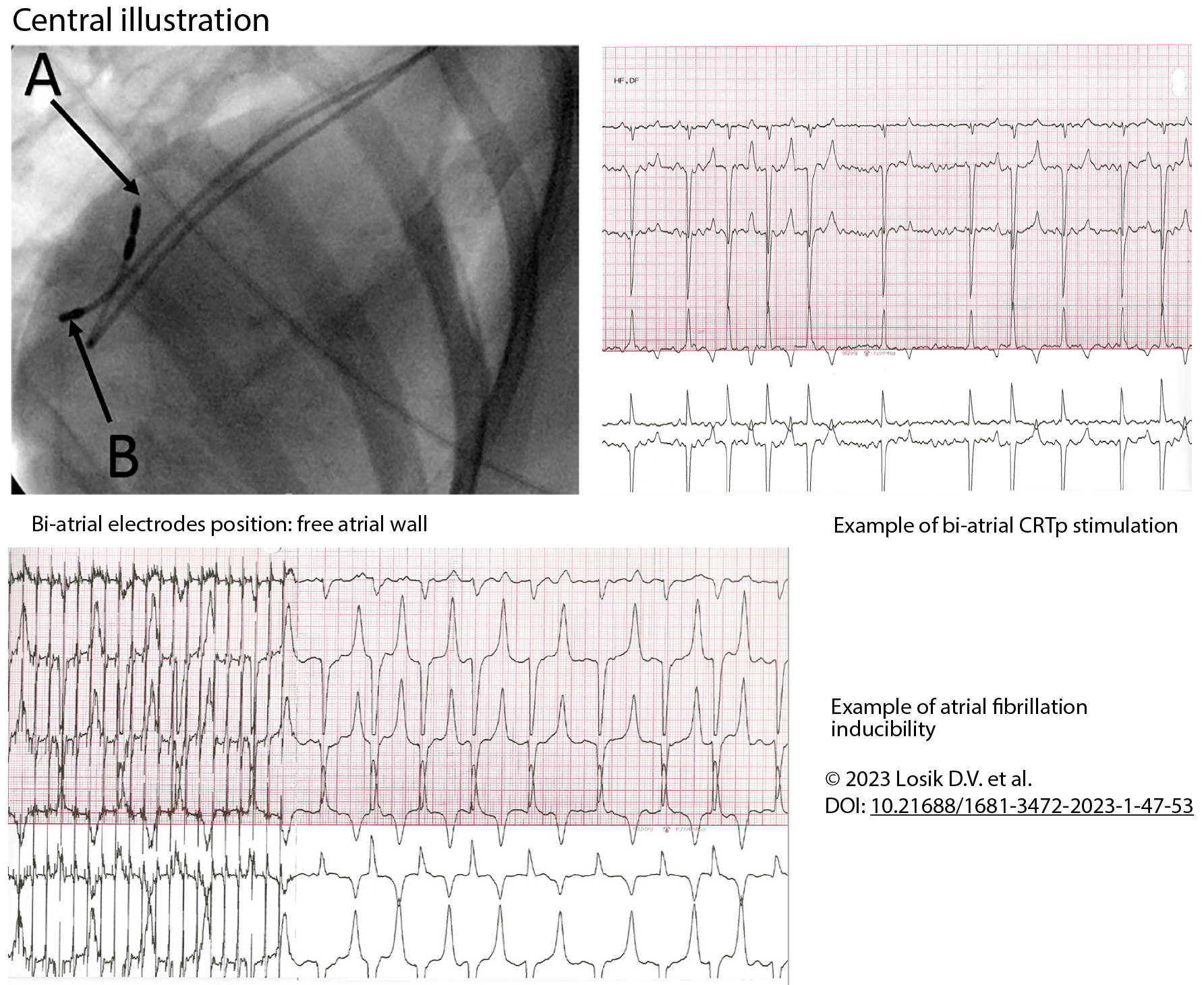
Methods: All surgical interventions were minimally invasive and conducted under general anaesthesia. CRT-P was implanted endocardially, using X-ray. First electrode was fixed in the right atrial appendage. The second one — in the interatrial septum or the right atrial free wall. Both of them were connected with CRT-P through RV/LV. Bi-electrode atrial stimulation was realized during a week with a basic heart rate of 150 bpm and a delay between electrodes of 80 ms (mean 450 bpm), which corresponds to the heart rate (HR) of AF. Electrophysiological study was performed during the experiment to analyze the cardiac conduction system. AF inducibility was evaluated before and after stimulation.
Results: A series of experiments demonstrated that there were no complications following the device and electrodes implantation. There was a non-sustained paroxysm of AF before permanent pacing in one of three pigs. After pacing we noted a tendency to increase the baseline HR (average frequency from 94 ± 4 to 98 ± 6 bpm). Non-sustained paroxysm of AF was induced in all cases. The sustained AF with 92 min burden was induced in one pig.
Conclusion: Endocardial bi-electrode atrial pacing in mini-pigs has proven to be safe. This AF model improves AF inducibility and can be considered as an alternative to epicardial stimulation for experiments employing AF models.
Received 4 December 2022. Revised 17 January 2023. Accepted 18 January 2023.
Funding: The study was supported by Russian Science Foundation (project No. 22-25-00672).
Conflict of interest: The authors declare no conflict of interest.
Contribution of the authors
Conception and study design: V.V. Beloborodov, D.V. Losik, E.V. Fisher
Data collection and analysis: E.V. Fisher, V.V. Beloborodov, D.V. Losik, A.G. Filippenko
Drafting the article: D.V. Losik, E.V. Fisher, V.I. Murtazin, V.V. Beloborodov
Critical revision of the article: A.B. Romanov, D.V. Losik, V.V. Shabanov, I.L. Mikheenko
Final approval of the version to be published: D.V. Losik, V.V. Beloborodov, E.V. Fisher, V.I. Murtazin, A.G. Filippenko, I.L. Mikheenko, V.V. Shabanov, A.B. Romanov
References
- Marrouche N.F., Brachmann J., Andresen D., Siebels J., Boersma L., Jordaens L., Merkely B., Pokushalov E., Sanders P., Proff J., Schunkert H., Christ H., Vogt J., Bänsch D.; CASTLE-AF Investigators. Catheter ablation for atrial fibrillation with heart failure. N Engl J Med. 2018;378(5):417-427. PMID: 29385358. https://doi.org/10.1056/NEJMoa1707855
- Alsunbuli A. Rhythm control treatment strategies for atrial fibrillation: current consensus and future possibilities. Clin Med (Lond). 2020;20(Suppl 2):s4-s5. PMID: 32409336; PMCID: PMC7243534. https://doi.org/10.7861/clinmed.20-2-s4
- Guo L., Dong Z., Guthrie H. Validation of a guinea pig Langendorff heart model for assessing potential cardiovascular liability of drug candidates. J Pharmacol Toxicol Methods. 2009;60(2):130-151. PMID: 19616638. https://doi.org/10.1016/j.vascn.2009.07.002
- Lee A.M., Miller J.R., Voeller R.K., Zierer A., Lall S.C., Schuessler R.B., Damiano R.J. Jr, Melby S.J. A Simple porcine model of inducible sustained atrial fibrillation. Innovations (Phila). 2016;11(1):76-78. PMID: 26889882; PMCID: PMC5551441. https://doi.org/10.1097/IMI.0000000000000230
- Стрельников А.Г., Лосик Д.В., Сергеевичев Д.С., Зыков И.С., Абашкин С.А., Романов А.Б., Покушалов Е.А. Нейротоксическая денервация автономной нервной системы левого предсердия в целях лечения и профилактики фибрилляции предсердий: экспериментальное исследование. Патология кровообращения и кардиохирургия. 2015;19(3):94-99. Strelnikov A.G., Losik D.V., Sergeyevichev D.S., Zykov I.S., Abashkin S.A., Romanov A.B., Pokushalov Ye.A. Neurotoxic denervation of the left atrium for atrial fibrillation treatment and prevention: an experimental animal study. Patologiya krovoobrashcheniya i kardiokhirurgiya = Circulation Pathology and Cardiac Surgery. 2015;19(3):94-99.
- Hindricks G., Potpara T., Dagres N., Arbelo E., Bax J.J., Blomström-Lundqvist C., Boriani G., Castella M., Dan G.A., Dilaveris P.E., Fauchier L., Filippatos G., Kalman J.M., La Meir M., Lane D.A., Lebeau J.P., Lettino M., Lip G.Y.H., Pinto F.J., Thomas G.N., Valgimigli M., Van Gelder I.C., Van Putte B.P., Watkins C.L.; ESC Scientific Document Group. 2020 ESC Guidelines for the diagnosis and management of atrial fibrillation developed in collaboration with the European Association for Cardio-Thoracic Surgery (EACTS): The Task Force for the Diagnosis and Management of Atrial Fibrillation of the European Society of Cardiology (ESC). Developed with the special contribution of the European Heart Rhythm Association (EHRA) of the ESC. Eur Heart J. 2021;42(5):373-498. PMID: 32860505. https://doi.org/10.1093/eurheartj/ehaa612
- Schüttler D., Bapat A., Kääb S., Lee K., Tomsits P., Clauss S., Hucker W.J. Animal models of atrial fibrillation. Circ Res. 2020;127(1):91-110. PMID: 32716814. https://doi.org/10.1161/CIRCRESAHA.120.316366
- Dosdall D.J., Ranjan R., Higuchi K., Kholmovski E., Angel N., Li L., Macleod R., Norlund L., Olsen A., Davies C.J., Marrouche N.F. Chronic atrial fibrillation causes left ventricular dysfunction in dogs but not goats: experience with dogs, goats, and pigs. Am J Physiol Heart Circ Physiol. 2013;305(5):H725-H731. PMID: 23812387; PMCID: PMC4116536. https://doi.org/10.1152/ajpheart.00440.2013
- Lin J.-L., Lai L.-P., Lin C.-S., Du C.-C., Wu T.-J., Chen S.-P., Lee W.-C., Yang P.-C., Tseng Y.-Z., Lien W.-P., Huang S.K.S. Electrophysiological mapping and histological examinations of the swine atrium with sustained (> or =24 h) atrial fibrillation: a suitable animal model for studying human atrial fibrillation. Cardiology. 2003;99(2):78-84. PMID: 12711882. https://doi.org/10.1159/000069728
- Frydrychowski P., Michałek M., Sławuta A., Noszczyk-Nowak A. Large animals as models of atrial fibrillation. Adv Clin Exp Med. 2020;29(6):757-767. PMID: 32603556. https://doi.org/10.17219/acem/122130
- Shen M.J., Choi E.K., Tan A.Y., Lin S.F., Fishbein M.C., Chen L.S., Chen P.S. Neural mechanisms of atrial arrhythmias. Nat Rev Cardiol. 2011;9(1):30-39. PMID: 21946776. https://doi.org/10.1038/nrcardio.2011.139
- Bernstein S.A., Wong B., Vasquez C., Rosenberg S.P., Rooke R., Kuznekoff L.M., Lader J.M., Mahoney V.M., Budylin T., Älvstrand M., Rakowski-Anderson T., Bharmi R., Shah R., Fowler S., Holmes D., Farazi T.G., Chinitz L.A., Morley G.E. Spinal cord stimulation protects against atrial fibrillation induced by tachypacing. Heart Rhythm. 2012;9(9):1426-33.e3. PMID: 22554859; PMCID: PMC3634125. https://doi.org/10.1016/j.hrthm.2012.04.038
- Wang S., Zhou X., Huang B., Wang Z., Zhou L., Chen M., Yu L., Jiang H. Spinal cord stimulation suppresses atrial fibrillation by inhibiting autonomic remodeling. Heart Rhythm. 2016;13(1):274-281. PMID: 26277494. https://doi.org/10.1016/j.hrthm.2015.08.018
- Olgin J.E., Takahashi T., Wilson E., Vereckei A., Steinberg H., Zipes D.P. Effects of thoracic spinal cord stimulation on cardiac autonomic regulation of the sinus and atrioventricular nodes. J Cardiovasc Electrophysiol. 2002;13(5):475-481. PMID: 12030530. https://doi.org/10.1046/j.1540-8167.2002.00475.x
- Cardinal R., Pagé P., Vermeulen M., Bouchard C., Ardell J.L., Foreman R.D., Armour J.A. Spinal cord stimulation suppresses bradycardias and atrial tachyarrhythmias induced by mediastinal nerve stimulation in dogs. Am J Physiol Regul Integr Comp Physiol. 2006;291(5):R1369-75. PMID: 16778070. https://doi.org/10.1152/ajpregu.00056.2006