Aortic stenting for aortic isthmus stenosis caused by the patent ductus arteriosus occluder: a case report
 R.S. Tarasov
- A.Yu. Kolesnikov
- I.E. Vereshchagin
Published 2022-12-29
Keywords
- Aorta,
- Case Report,
- Child,
- Ductus Arteriosus,
- Patent
- Stents ...More
How to Cite
Copyright (c) 2022 Tarasov R.S., Kolesnikov A.Yu., Vereshchagin I.E.

This work is licensed under a Creative Commons Attribution 4.0 International License.
Abstract
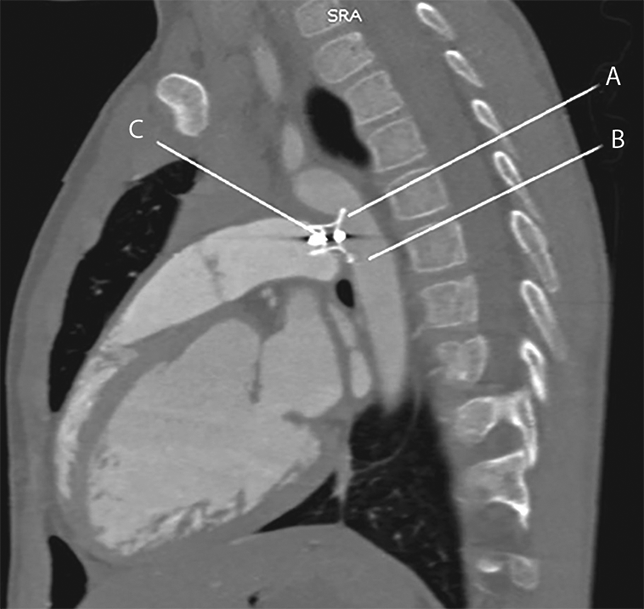
We present a case report of stenting the aortic isthmus to manage a rare complication – stenosis caused by the patent ductus arteriosus occlude previously implanted to a child at the age of 7 months. After 7 years the patient was re-admitted to the cardiology hospital with the signs and symptoms of the aortic coarctation. The echocardiography revealed a peak pressure gradient of 40 mm Hg in the area of the aortic isthmus. The pressure gradient between the upper and lower extremities was 25-30 mm Hg. At the age of 8 the compromised blood flow in the aorta was completely resolved by stenting the aortic isthmus with covering of the implanted occluder. Andrastent XL (Andramed GmbH, Reutlingen, Germany) stent was implanted. Characteristics of this stent allow expanding it up to 14 mm. The pressure gradient in the area of the aortic isthmus was completely eliminated after the procedure. The effectiveness of the intervention was confirmed after 7 months with echocardiography. In conclusion, the aortic stenting using devices with the potential for further expansion as the child grows is justified due to its effectiveness, minimal invasiveness, and radical nature.
Received 5 March 2022. Revised 10 July 2022. Accepted 11 July 2022.
Informed consent: The patient’s informed consent to use the records for medical purposes is obtained.
Funding: The study did not have sponsorship.
Conflict of interest: Authors declare no conflict of interest.
Contribution of the authors: The authors contributed equally to this article.
References
- Рентгенэндоваскулярная хирургия: национальное руководство. В 4 т. / Под ред. Б.Г. Алекяна. М.: Литтерра, 2017. Т. 1: Врожденные пороки сердца. 2017. 573 с. Alekyan B.G., editor. Endovascular surgery: national guidelines. In 4 vol. Moscow: Litterra Publ.; 2017. Vol. 1: Congenital heart disease. 2017. 573 p. (In Russ.)
- Haponiuk I., Paczkowski K., Chojnicki M., Jaworski R. Iatrogenic obstruction of the aorta — a sequence of delayed, fatal complications after 'off-label' interventional persistent ductus arteriosus closure. Wideochir Inne Tech Maloinwazyjne. 2016;11(1):44-48. PMID: 28133500; PMCID: PMC4840184. http://dx.doi.org/10.5114/wiitm.2016.57620
- Backes C.H., Rivera B.K., Bridge J.A., Armstrong A.K., Boe B.A., Berman D.P., Fick T., Holzer R.J., Hijazi Z.M., Abadir S., Justino H., Bergersen L., Smith C.V., Kirpalani H. Percutaneous Patent Ductus Arteriosus (PDA) closure during infancy: a meta-analysis. Pediatrics. 2017;139(2):e20162927. PMID: 28087683. http://dx.doi.org/10.1542/peds.2016-2927
- Sathanandam S., Gutfinger D., Morray B., Berman D., Gillespie M., Forbes T., Johnson J.N., Garg R., Malekzadeh-Milani S., Fraisse A., Baspinar O., Zahn E.M. Consensus Guidelines for the Prevention and Management of Periprocedural Complications of Transcatheter Patent Ductus Arteriosus Closure with the Amplatzer Piccolo Occluder in Extremely Low Birth Weight Infants. Pediatr Cardiol. 2021;42(6):1258-1274. PMID: 34195869; PMCID: PMC8292293. http://dx.doi.org/10.1007/s00246-021-02665-3
- Alkhouli M., Sievert H., Rihal C.S. Device embolization in structural heart interventions: incidence, outcomes, and retrieval techniques. JACC Cardiovasc Interv. 2019;12(2):113-126. PMID: 30678792. http://dx.doi.org/10.1016/j.jcin.2018.08.033
- Chien Y.-H., Wang H.-H., Lin M.-T., Lin H.-C., Lu C.-W., Chiu S.-N., Wu M.-H., Wang J.-K., Chen C.-A. Device deformation and left pulmonary artery obstruction after transcatheter patent ductus arteriosus closure in preterm infants. Int J Cardiol. 2020;312:50-55. PMID: 32143922. http://dx.doi.org/10.1016/j.ijcard.2020.02.065
- Dimas V.V., Leonard S.R., Guleserian K.J., Forbess J.M., Zellers T.M. Stent implantation for coarctation of the aorta in a premature infant through carotid cutdown as a bridge to surgical correction. J Thorac Cardiovasc Surg. 2010;139(4):1070-1071. PMID: 19660357. http://dx.doi.org/10.1016/j.jtcvs.2008.10.055
- Keelan E.T., Nunez B.D., Berger P.B., Holmes D.R. Jr, Garratt K.N. Management of balloon rupture during rigid stent deployment. Cathet Cardiovasc Diagn. 1995;35(3):211-215. PMID: 7553825. ttps://dx.doi.org/10.1002/ccd.1810350310